Price vs Value: The Difference Most Clinicians Miss
Aug 12, 2026
One of the biggest mistakes clinicians make when they enter the world of business is not understanding the difference between value and price.
Once you get that they’re not the same thing, you’ll start to see why some people can consistently charge higher for their services… and why others never escape the pricing trap.
Quick intro. I’m Phil. I’m a business architect for health practitioners. I’ve been selling health products and services for the last 10 years — personal training, physiotherapy, retreats, workshops, digital courses, the lot.
Let’s get into it.
There are three things you need to understand about the difference between price and value:
- Value is subjective to the patient
- Price and value can be the same thing — but most times they’re not
- Value is multi-dimensional (and often invisible until someone experiences it)
If you'd rather see the video version, check it out here:
1. Value is Subjective to the Person
Have you ever wondered why someone would pay $5,000 for a coaching program while someone else would only pay $100 for the exact same service?
Here’s a clear example.
Coach A charges $47/week. They market their program as helping everyday people get in the best shape of their life. Workouts, calorie tracking, recipes — the works.
Coach B offers the exact same type of service… but charges $197/week. They market it as helping people become the sexiest, most in-demand, most desirable person in the room.
Same service. Completely different value.
Coach A attracts everyday people who just want to improve their health and lose a few kilos. Being the sexiest person in the room might sound nice, but it’s not their main driver. A lot of them are already married.
Coach B is targeting men and women who have a deep desire to be wanted — to get their dream partner, to have options, to finally feel like the most desirable person in the room.
That’s the difference between $47 and $197 a week. The value of the program depends entirely on what the prospect considers most important.
Value is driven by the depth and intensity of the problem for that specific person.
Let’s take it outside of health for a second.
A Toyota Camry is priced around $40k and costs about $20k to make. A Ferrari is priced around $300k and costs about $120k to make. The margin percentage is similar — but the absolute price difference is massive.
Who buys a Camry? Everyday people. Mums and dads. Middle-class families who need a reliable car that will last and has space for the kids.
Who buys a Ferrari? Not the family man who needs room for a baby seat. In pure utility terms, a Ferrari is often worse — less practical space, more expensive to maintain, more headache.
And yet people still pay $300k for one.
Why? Because what they value isn’t utility or back-seat space. What they value is what the Ferrari represents. Status. Success. Identity. The feeling of having “made it.”
Neither of these examples is really about price. It’s about what the customer values and deems important in their life.
2. Price and Value Can Be the Same — But Most Times They’re Not
Price and value become the same thing only when the buyer’s entire value system is tied to price or return on investment.
Think of someone investing in stocks purely for an 8% return. Their only focus is how much money it’s going to make them. Higher return + lower risk = higher value.
Or someone buying a property they’ve never even seen — purely because it’s projected to rise 200% over the next few years.
This is also why some businesses do extremely well with heavy discounts and low prices. They’re specifically targeting people whose main value driver is price and bargaining.
That’s why value often gets confused with price — it’s the easiest thing for people to measure.
But here’s where they clearly diverge in health:
- A specialist with proven expertise in your exact problem (e.g. ACL rehab for performance basketball athletes) is highly valuable. You can’t put a clean price tag on that trust and track record — but people will pay for it.
- The cleanliness of a clinic or gym has no direct monetary value, yet people notice it and value it. That’s why premium practices obsess over it.
- Time. If you only have three months to transform your body for a wedding, a coach with a track record of aggressive results becomes extremely valuable. Speed itself becomes something people will pay for.
3. Value Is Multi-Dimensional (And Often Invisible Until You Experience It)
A lot of people don’t value something until it’s created in front of them.
Before the iPhone, most people had no idea you could operate a phone with just your finger. Some would have laughed at the idea. Now every device is touch-based and almost no one wants to go back.
Same with seat warmers. I never experienced them until a few years ago. It completely changed how I viewed the car experience. Would I pay extra for them on their own? Probably not. But if two cars are the same price and one has them? I’m picking the one with seat warmers.
In health, most patients don’t walk into an appointment thinking about whether their physio can explain things clearly or speak well. But the moment they work with someone who can’t versus someone who can… they immediately start valuing the clear communicator.
There are hidden elements of value that most clinicians never think about:
- Speaking ability
- Listening ability
- Niche specialties
- Unique points of view
- Practice cleanliness
- How the practice smells
- The view from the treatment room
These are multi-dimensional value drivers. They’re often not obvious to the patient at the start — but once experienced, they completely change what someone is willing to pay.
Quick Recap
To understand the difference between price and value, remember these three things:
- Value is subjective — what one person considers important is not the same for another, and it has nothing to do with the price tag.
- Price and value can be the same — but only for people whose main value driver is price or ROI.
- A lot of value is multi-dimensional and not obvious until it’s experienced. Spend time perfecting the entire patient experience.
That’s the difference.
Use this as you build your business and practice. Be bold. Be brave. Don’t be afraid to step outside the box with the value you provide.
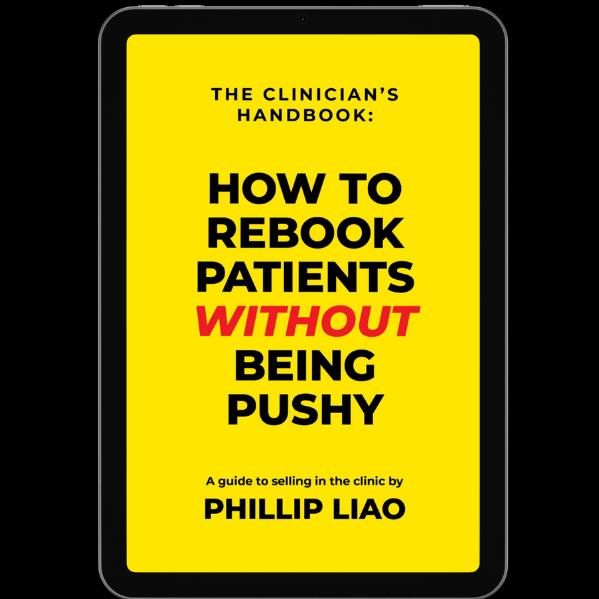
If you want to get better at rebooking patients without being pushy, I’ve written a book called How to Rebook Patients Without Being Pushy. It’s helped over 700 clinicians worldwide. You can grab your copy below.
Talk soon, Phil
Join 700+ Clinicians With The Bestseller 'How To Rebook Patients Without Being Pushy'